Why 40% of Agentic AI Projects Will Fail — And How Synth Changes the Math
In June 2025, Gartner published a prediction that landed like a grenade in enterprise AI circles: more than 40% of agentic AI projects will be canceled by the end of 2027. The number made headlines. It also understated the problem. Anecdotally, many enterprises we speak with across financial services, healthcare, and government describe failure rates that exceed Gartner's prediction. Most organizations that kicked off agentic AI pilots in 2025 have quietly shelved them. The demos were impressive. The production deployments never materialized.
This is not a technology problem. The underlying models are more capable than ever. The tooling ecosystem around function calling, tool use, and multi-step reasoning has matured dramatically. The problem is structural: organizations are building agentic AI systems without the operational scaffolding those systems require. They are treating autonomous software agents like chatbot upgrades instead of what they actually are — production software that makes decisions, takes actions, and interacts with real systems on behalf of real users.
After working with dozens of teams through failed and successful agentic deployments, we have identified four failure modes that account for the vast majority of project deaths. Each one is predictable. Each one is preventable. And our platform was designed specifically to eliminate them — with governed tool synthesis (OATS), intelligent model routing (SmartModelRouter), immutable audit trails, and sandbox execution built into a single integrated system.
Failure Mode 1: Ungoverned Tool Sprawl
The first thing most teams do when building an agentic AI system is start collecting tools. They integrate a web search API. Then a database connector. Then a code execution environment. Then a Slack integration, a Jira connector, a Salesforce adapter, a custom internal API wrapper. Within weeks, the agent has access to fifteen different tools, each with its own authentication model, rate limits, error handling patterns, and data formats.
This is tool sprawl, and it kills projects in two ways. First, it creates an exponentially growing surface area for failures. Every new tool integration is a new dependency that can break, timeout, return unexpected data, or introduce security vulnerabilities. Second, it makes the system impossible to reason about. When an agent has access to fifteen tools and chains them in novel combinations, no human reviewer can confidently predict what the system will do in edge cases. The team loses the ability to answer the most basic production question: what can this thing actually do?
How OATS Addresses It: Intent-Based Tool Synthesis
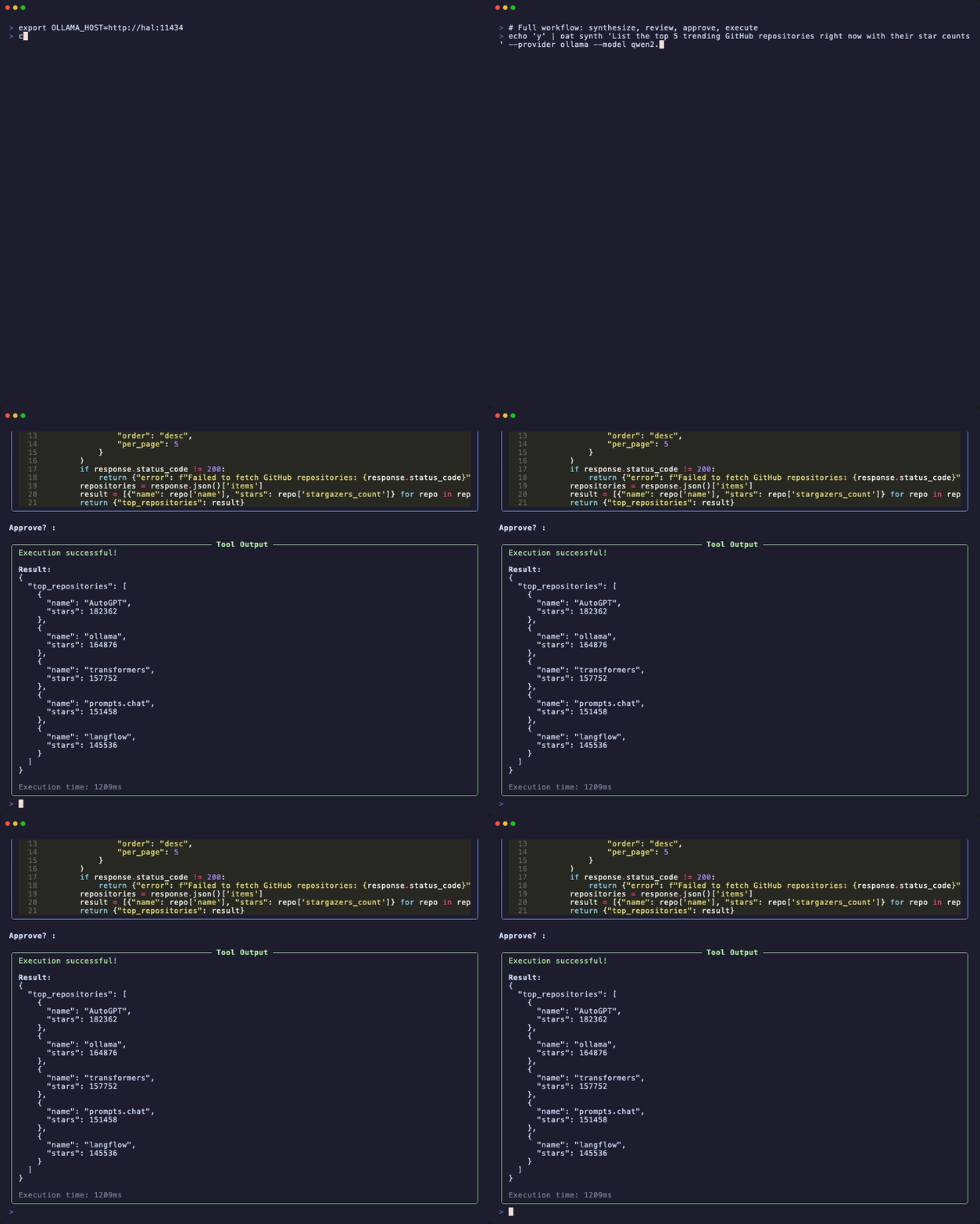
OATS takes a fundamentally different approach to tooling. Instead of pre-registering a growing library of tool integrations, OATS uses intent-based tool synthesis. You describe what you need the agent to accomplish — not which specific APIs to call. The orchestration layer synthesizes the appropriate tool configuration on demand, constrained by the permissions and policies you have defined.
This means the tool surface area is always bounded by intent, not by an ever-growing registry. New capabilities do not require new integrations. They require new permission grants. The governance model stays tractable because you are managing what agents are allowed to do, not which specific API endpoints they can hit. The difference sounds subtle. In practice, it is the difference between a system you can audit and a system you cannot.
Failure Mode 2: No Audit Trail (Compliance Kills the Project)
Here is a pattern we see repeatedly: an engineering team builds a working agentic AI prototype. It performs well. Leadership is excited. Then the project goes to compliance review. The compliance team asks three questions: What decisions did the agent make? Who approved them? Can you reproduce the decision chain for a given output? The engineering team cannot answer any of them. The project is dead.
This is not a niche concern limited to regulated industries. Every enterprise that deploys AI agents acting on behalf of employees or customers will eventually face these questions — from regulators, from auditors, from legal counsel after an incident, or from their own risk management teams. The EU AI Act, the NIST AI Risk Management Framework, and sector-specific regulations in finance and healthcare all require varying degrees of explainability and traceability for automated decision-making systems. An agent that takes actions without a clear audit trail is a compliance liability waiting to detonate.
How OATS Addresses It: Mandatory HITL Gates and Full Action Logging
In the OATS framework, human-in-the-loop (HITL) gates are not optional add-ons. They are architectural primitives. Every action an agent takes — every tool invocation, every external API call, every data mutation — is logged with full context: what the agent intended, what inputs it received, what output it produced, and whether a human approved the action before execution.
HITL gates are configurable by risk level. Low-risk, well-understood operations can be auto-approved with logging. High-risk operations — anything involving PII, financial transactions, or irreversible state changes — require explicit human approval before the agent proceeds. The key insight is that this is not a bolted-on approval workflow. It is woven into the execution model. The agent cannot bypass the gate because the gate is the execution path. The audit trail is not a report you generate after the fact. It is the native record of how the system actually operated.
The question is not whether your AI agents need governance. The question is whether you build it in from day one or bolt it on after the first incident. One of those options is dramatically cheaper than the other.
Failure Mode 3: Vendor Lock-In (Switching Costs Spiral)
Most agentic AI platforms today are tightly coupled to a single model provider. Your agent logic is written against OpenAI's function calling format, or Anthropic's tool use schema, or Google's Gemini API. Your prompts are optimized for one model's behavior. Your tool definitions use one provider's schema. Six months in, you discover that a different model performs better for your specific use case, or your provider raises prices by 40%, or a new model with dramatically better reasoning capabilities launches. You are stuck. The switching cost is a rewrite.
This lock-in extends beyond models. Many agentic platforms lock you into their hosting, their observability stack, their tool ecosystem. You cannot run the system on your own infrastructure. You cannot bring your own monitoring. You cannot export your agent configurations in a portable format. Every month that passes, the cost of leaving increases. This is not a theoretical concern — it is the business model.
How OATS Addresses It: SmartModelRouter and Deploy-Anywhere Architecture
OATS includes a SmartModelRouter that abstracts model selection from agent logic. Your agents define their requirements — reasoning depth, speed, cost constraints, context window needs — and the router selects the optimal model at runtime. Swap providers by changing a configuration line, not by rewriting your agent code. Run the same agent on GPT-4o for one task and Claude for another, transparently, based on performance characteristics you define.
More importantly, OATS is self-hosted and designed to deploy anywhere. Run it on your own Kubernetes cluster, on a single VM, on any major cloud provider, or in an air-gapped environment. There is no proprietary runtime. There is no hosted-only mode. Your agent configurations, tool definitions, and orchestration logic are yours — portable, auditable, and version-controlled in your own repositories. The framework does not have a business model that depends on making it hard to leave. That changes the power dynamic fundamentally.
Failure Mode 4: The Demo-to-Production Gap
This is the failure mode that catches the most teams off guard. The agent works beautifully in a Jupyter notebook. It handles the demo scenario flawlessly. Then you try to deploy it to production and everything falls apart. The agent needs access to production databases, but nobody thought about credential management. It works with test data, but production data has encoding issues, missing fields, and edge cases the prototype never encountered. It runs fine with a single user, but collapses under concurrent requests. The error handling that was "good enough" for a demo — catching exceptions and printing a stack trace — is catastrophically inadequate for a system that processes customer requests at 3 AM with no engineer watching.
The demo-to-production gap is not a single problem. It is a category of problems that all stem from the same root cause: the development environment was so different from the production environment that success in one predicted nothing about success in the other. Prototype-grade tooling gives you prototype-grade systems. Every time.
How OATS Addresses It: Sandboxed Execution and Production-Grade Defaults
The "S" in OATS stands for Sandbox, and it is not an afterthought. Every agent in OATS executes inside an isolated sandbox with explicit resource boundaries, credential scoping, and network policies. This is not just a security feature — it is a development methodology. When you build an agent in OATS, you are building it inside the same execution model it will use in production from the very first line of code.
Credentials are managed through a dedicated isolation layer. Agents never see raw secrets. They receive scoped, time-limited access tokens with the minimum permissions required for their current task. Network access is policy-controlled — an agent cannot reach an endpoint it has not been explicitly granted access to. Resource consumption is bounded and monitored. These are not features you enable when you "move to production." They are the default execution model. There is no gap between dev and prod because there is no separate dev mode. You are always running production-grade infrastructure, even during development.
- Credential isolation: Scoped, rotatable tokens instead of shared secrets embedded in agent code
- Network policy enforcement: Explicit allowlists for every external endpoint an agent can reach
- Resource bounding: CPU, memory, and execution time limits per agent invocation
- Deterministic replay: Full input/output capture enables reproducing any agent execution for debugging
The 60% That Succeed
If Gartner is right that 40% of agentic AI projects will fail, then 60% will succeed. The interesting question is what separates the two groups. Having watched both outcomes play out across dozens of organizations, the pattern is clear: the teams that succeed are the ones that treat AI agents as production software from the start.
They do not prototype with notebooks and plan to "productionize later." They do not skip governance because "we'll add it before launch." They do not hard-code a single model provider because "we can always switch." They do not collect tools like trading cards and hope the agent figures out how to use them responsibly.
Instead, they start with the operational questions. How will we audit this? How will we control what it can access? How will we swap models when the landscape shifts? How will we ensure the dev environment matches production? These are not exciting questions. They do not make for good demo videos. But they are the questions that determine whether a project ships or dies in review.
The platform exists because these questions deserve architectural answers, not procedural ones. You should not need a 40-page runbook to deploy an AI agent safely. The platform should make the safe path the easy path — and the unsafe path the one that requires deliberate effort to reach.
Agentic AI is real. The capabilities are here. The failure rate is not a reflection of the technology's limitations. It is a reflection of how organizations are deploying it. Change the deployment model, and you change the math.
How Our Platform Prevents These Failure Modes
Each failure mode maps to a specific platform capability. OATS handles tool synthesis so agents don't need hundreds of pre-built integrations (Failure Mode 1). But the broader platform addresses the rest. SmartModelRouter eliminates vendor lock-in with an Intelligence Slider that routes across 15+ model families through 5 provider integrations — swap models by adjusting a slider from 0 to 100, not by rewriting agent code. The platform's Audit System provides the immutable, cryptographically hashed logs that compliance teams require: every agent decision, every tool invocation, every approval is recorded in a tamper-evident trail that satisfies EU AI Act and NIST AI RMF requirements out of the box.
For teams struggling with the demo-to-production gap, our platform's Workflow Builder lets you visually construct agent pipelines with configurable node types, built-in HITL approval gates, and automatic deployment as REST endpoints. The workflows run on K8s-native infrastructure that works identically in development and production — including air-gapped and on-prem environments. The gap disappears because there is no separate "production mode" to migrate to.